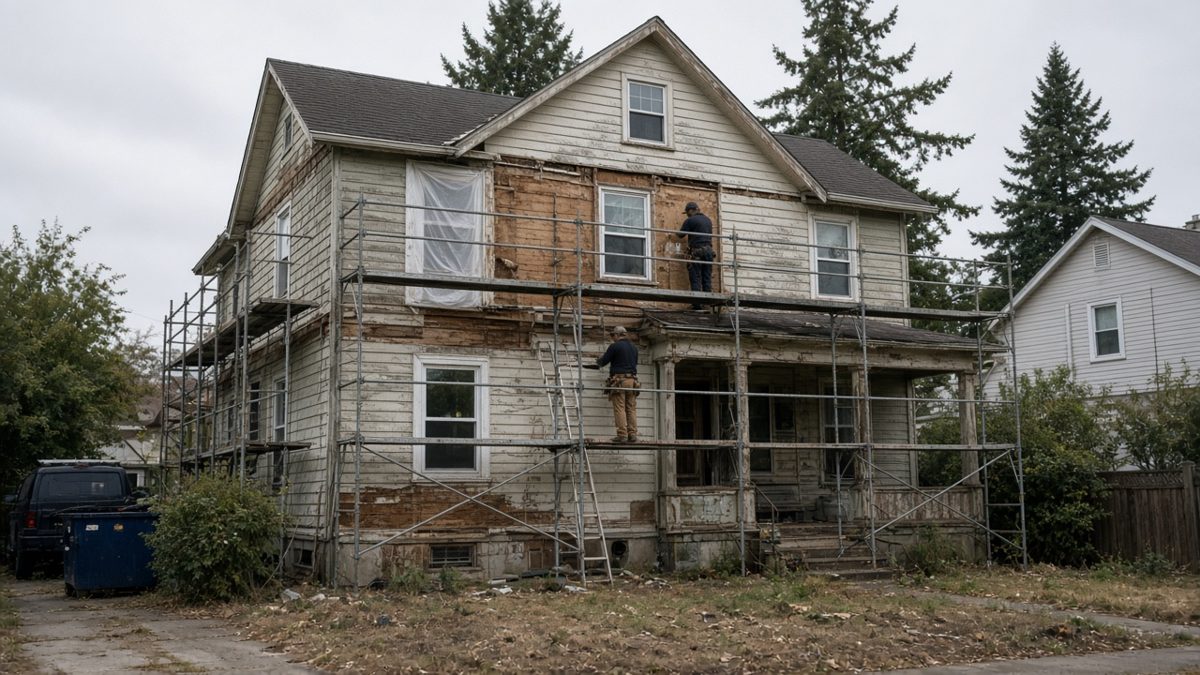
Fixer-upper homes often sell for less than move-in-ready houses, but buyers face a problem: a standard mortgage covers only the purchase price, and repairs can cost tens of thousands of dollars more. The FHA 203(k) loan addresses that by letting you roll the cost of renovations into one mortgage, insured by the Federal Housing Administration. With a down payment as low as 3.5% for qualified borrowers, it can make a home that needs work affordable for buyers who lack large cash reserves. This guide explains how the 203(k) program works, its two versions, what work it covers, and what to expect from the process.
What an FHA 203(k) loan is
The 203(k) program is part of the FHA’s mortgage insurance programs, administered by the Department of Housing and Urban Development (HUD). It lets borrowers finance both the purchase or refinance of a home and the cost of rehabilitating it. The loan amount is based on either the property’s value before renovation plus the cost of improvements or a percentage of the projected value after improvements, whichever is less, subject to FHA loan limits for the county.
At closing, the purchase portion pays the seller. The renovation funds are placed in an escrow account and released to contractors as work is completed.
Limited vs. standard 203(k)
| Feature | Limited 203(k) | Standard 203(k) |
|---|---|---|
| Renovation amount | Up to $75,000 | Minimum $5,000, up to FHA loan limits |
| Structural repairs | Not allowed | Allowed |
| HUD consultant | Not required | Required |
| Best for | Cosmetic and minor repairs | Major renovations and structural work |
HUD raised the limited 203(k) cap to $75,000 in 2024. Confirm current limits with your lender, since program rules can change.
Limited 203(k)
The limited version is designed for nonstructural repairs and upgrades, such as:
- Kitchen and bathroom remodels without structural changes
- New flooring, paint, and fixtures
- Roof repair or replacement
- New HVAC, water heater, or plumbing and electrical updates
- Energy-efficiency improvements
- Accessibility improvements
Standard 203(k)
The standard version covers larger projects, including:
- Structural repairs and foundation work
- Room additions
- Major remodeling
- Relocating a home to a new foundation
- Rebuilding on an existing foundation in some cases
A HUD-approved 203(k) consultant inspects the property, prepares a work write-up and cost estimate, and approves draw requests as work proceeds.
What a 203(k) loan cannot be used for
Luxury improvements generally are not allowed, such as swimming pools, outdoor hot tubs, tennis courts, or barbecue pits. Some items like existing pool repairs may be allowed in limited cases. Ask your lender for the program’s list of eligible and ineligible improvements.
Borrower requirements
FHA 203(k) loans follow general FHA guidelines, including:
- Credit score. FHA allows a 3.5% down payment with a credit score of 580 or higher, and 10% down with scores from 500 to 579. Many lenders set higher minimums for 203(k) loans, often around 620 or more, because of the added complexity.
- Down payment. At least 3.5% for qualifying borrowers.
- Debt-to-income ratio. FHA guidelines typically look for a DTI near 43% or lower, though higher ratios may be approved with compensating factors.
- Owner occupancy. The home must be your primary residence. Investors generally cannot use the program.
- Property type. One- to four-unit homes, some condominiums, and certain mixed-use properties may qualify.
- Mortgage insurance. FHA loans require an upfront mortgage insurance premium and annual premiums.
Costs to expect
Compared with a standard FHA loan, a 203(k) loan can involve additional costs:
- Higher interest rates. Lenders often charge somewhat more because of the extra work involved.
- Supplemental origination fee. Lenders may charge a fee on the renovation portion.
- Consultant fees, for standard 203(k) loans.
- Inspection and title update fees for each draw.
- Contingency reserve. Lenders may require a reserve, often 10% to 20% of renovation costs, especially for older homes, to cover unexpected issues.
- Mortgage payment reserves. If you cannot live in the home during renovation, up to six months of payments may be financed.
How the 203(k) process works
- Find a lender approved for 203(k) loans. Not all FHA lenders offer them.
- Find the property and get a purchase contract, ideally noting that financing is a 203(k) loan.
- Hire a consultant, if using the standard program, to prepare the work write-up.
- Get contractor bids. Contractors must be licensed and insured, and the lender will review their bids.
- Get the appraisal. The appraiser estimates the home’s after-improved value based on the planned work.
- Close on the loan. Renovation funds go into escrow.
- Complete the work. Contractors are paid in draws after inspections. Limited 203(k) work generally must be completed within a set period, and standard 203(k) timelines are set in the work plan.
- Final inspection and closeout. Remaining funds from the contingency reserve may be applied to the loan balance.
An example
Suppose a buyer finds a 1960s house listed for $250,000 in a neighborhood where updated homes sell for much more. The house needs a new roof, updated electrical panel, and a kitchen remodel, estimated at $60,000. With a limited 203(k), the buyer could finance the purchase price plus the $60,000 in repairs, subject to the appraisal and FHA loan limits, and put down 3.5% of the total. Instead of paying for the repairs in cash or with high-interest credit after closing, the buyer has one monthly mortgage payment. If the after-improved value appraises well, the buyer may also gain equity once the work is complete. The numbers are illustrative; actual loan amounts depend on appraisals, limits, and lender rules.
Using a 203(k) to refinance
Current homeowners can also use a 203(k) loan to refinance an existing mortgage and add renovation funds. This can help owners who want to modernize an aging home but lack the equity for a cash-out refinance or a home improvement loan. The same rules on eligible work, contractors, and draws apply, and the home must remain your primary residence.
Pros and cons
Advantages
- Finance purchase and repairs in one loan with one closing
- Low down payment
- More flexible credit requirements than many conventional renovation loans
- Can make it possible to buy homes that do not qualify for standard financing because of their condition
- Can be used to refinance and renovate a home you already own
Disadvantages
- More paperwork and a longer closing timeline
- Higher costs and fees than a standard FHA loan
- Mortgage insurance premiums
- Owner-occupants only
- Contractor delays can complicate the timeline
Alternatives to a 203(k) loan
- Fannie Mae HomeStyle Renovation and Freddie Mac CHOICERenovation loans are conventional renovation mortgages that may suit borrowers with stronger credit, allow investment properties in some cases, and let mortgage insurance be removed later.
- VA renovation loans are available to eligible veterans through some lenders.
- Personal loans or cash can cover smaller projects without a full mortgage process.
- Cash-out refinance may work for current owners with equity.
Tips for a smooth 203(k) loan
- Choose a lender and contractor with 203(k) experience.
- Get detailed, itemized bids.
- Build a realistic timeline and budget, and avoid change orders.
- Keep your lender informed of progress and delays.
- Plan where you will live during major renovations.
Related reading: How a HELOC Works: Draw Periods, Variable Rates, and Smart Ways to Use Home Equity.
Frequently Asked Questions
What is an FHA 203(k) loan?
It is an FHA-insured mortgage that combines the purchase or refinance of a home with the cost of renovations in a single loan, with funds for repairs held in escrow and released as work is completed.
How much can I borrow for repairs with a limited 203(k)?
The limited 203(k) allows up to $75,000 in renovation costs for nonstructural repairs. The standard 203(k) has a $5,000 minimum and allows larger projects up to FHA loan limits.
What credit score do I need for a 203(k) loan?
FHA allows a 3.5% down payment with a score of 580 or higher, but many lenders require higher scores, often around 620 or more, for 203(k) loans.
Can I do the work myself with a 203(k) loan?
Generally, lenders require licensed and insured contractors. Self-help work is allowed only in limited circumstances with lender approval.
Can investors use an FHA 203(k) loan?
No. The home must be the borrower’s primary residence, so investors generally cannot use the program.
This article is for general informational purposes only and is not legal, medical, tax, or financial advice. Rules vary by state and change over time; confirm details with the relevant agency or a licensed professional.