Working from home is common, but claiming a tax deduction for it is more restricted than many people expect. The home office deduction is available to self-employed people and certain business owners who use part of their home for business under specific IRS tests. Done correctly, it can reduce both income tax and self-employment tax. Done carelessly, it can trigger questions from the IRS. This guide explains who qualifies for the home office deduction, how to calculate it, and how to avoid common errors.
Who can claim the home office deduction
The deduction is generally available to:
- Self-employed individuals, including sole proprietors, freelancers, independent contractors, and gig workers who report income on Schedule C.
- Partners who meet certain requirements and pay expenses that are not reimbursed by the partnership.
- Owners of farms reporting on Schedule F.
What about W-2 employees?
Most employees cannot claim the deduction. The Tax Cuts and Jobs Act of 2017 suspended miscellaneous itemized deductions, including unreimbursed employee expenses, for tax years 2018 through 2025, and later legislation made that suspension permanent. If you are a W-2 employee working from home, your employer may reimburse home office costs through an accountable plan, but you generally cannot deduct those costs yourself. Certain groups, such as armed forces reservists and qualified performing artists, have narrow exceptions.
If you have both a W-2 job and a side business, you may claim the deduction for space used for the side business, provided it meets the tests below.
The two main tests
Regular and exclusive use
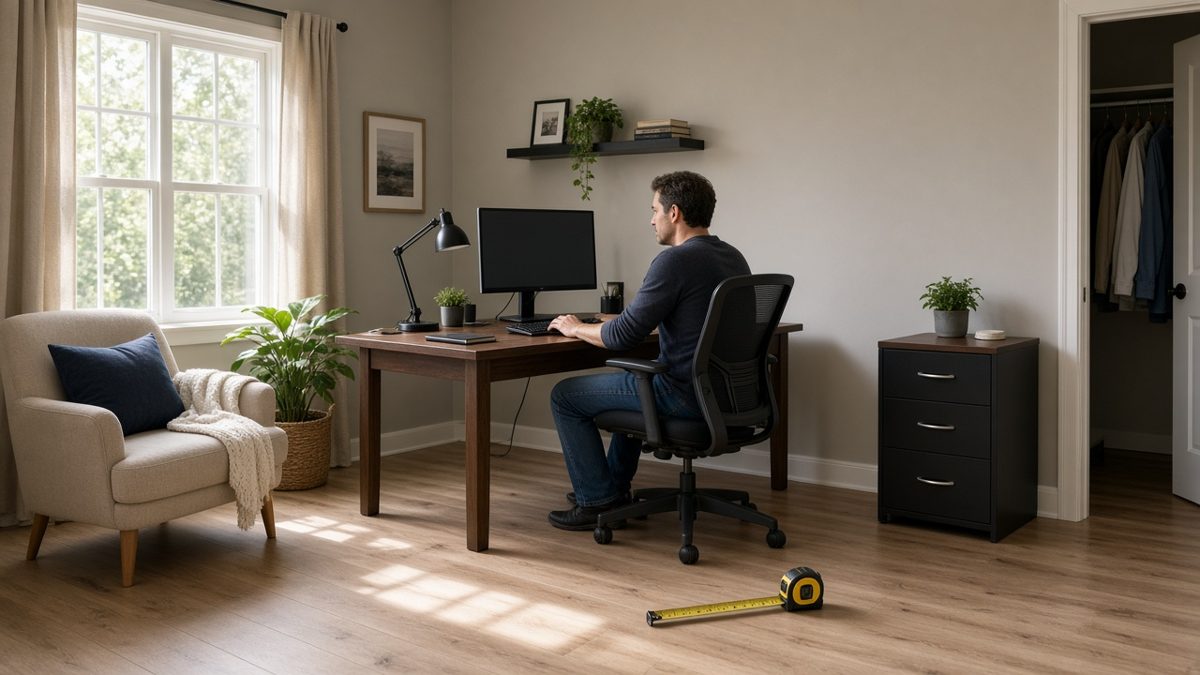
You must use a specific area of your home regularly and exclusively for business. A spare bedroom used only as an office qualifies. A dining table where you work during the day and eat dinner at night does not. The space does not have to be a separate room; a clearly defined portion of a room can qualify if used only for business.
There are two exceptions to the exclusive-use rule: space used to store inventory or product samples, under certain conditions, and space used as a licensed day care facility.
Principal place of business
The space must also meet one of these:
- It is your principal place of business. This includes a home office used for administrative or management activities, such as billing and scheduling, if there is no other fixed location where you conduct substantial administrative work.
- You use it to meet clients or customers in the normal course of business.
- It is a separate structure, such as a detached studio or garage, used in connection with your business.
Two ways to calculate the deduction
The simplified method
The IRS simplified option lets you deduct $5 per square foot of qualifying office space, up to 300 square feet, for a maximum deduction of $1,500 per year.
- No need to track actual home expenses.
- No depreciation, so no depreciation recapture later.
- You can still deduct mortgage interest and property taxes in full as itemized deductions if eligible, because none of them are allocated to the office.
- The deduction cannot create a business loss, and any amount limited by income cannot be carried forward.
The regular method
The regular method deducts the business share of actual home expenses, calculated on Form 8829. Start by figuring the business-use percentage:
Business percentage = office square footage ÷ total home square footage
Then apply that percentage to indirect expenses, which benefit the whole home:
- Mortgage interest or rent
- Real estate taxes
- Homeowners or renters insurance
- Utilities
- General repairs and maintenance
- Depreciation of the home, for owners
- HOA fees
Direct expenses, which benefit only the office, such as painting the office or repairs inside it, are deductible in full. Expenses that benefit only the non-business part of the home, such as landscaping in many cases, are not deductible.
Comparing the methods
| Feature | Simplified | Regular |
|---|---|---|
| Calculation | $5 × square feet, up to 300 | Actual expenses × business percentage |
| Maximum | $1,500 | No fixed cap; limited by income |
| Recordkeeping | Minimal | Detailed receipts |
| Depreciation | None | Yes, for owners |
| Carryover of excess | No | Yes |
An example
Suppose you rent a 1,200-square-foot apartment and use a 150-square-foot room exclusively as an office. That is 12.5% of the home. Annual rent is $24,000, utilities are $2,400, and renters insurance is $240, for $26,640 in total. Under the regular method, the deduction is about $3,330. Under the simplified method, it is 150 × $5 = $750. In this case the regular method yields a much larger deduction, but it requires records for every expense.
You may choose either method each year, though switching from simplified back to regular involves specific depreciation calculations explained in the Form 8829 instructions.
The income limitation
The home office deduction cannot exceed the gross income from the business use of your home, minus other business expenses. Under the regular method, disallowed amounts can be carried forward to future years. Under the simplified method, they cannot.
Depreciation and selling your home
Homeowners using the regular method claim depreciation on the business portion of the home, generally over 39 years as nonresidential real property. When you sell, the depreciation you claimed, or were entitled to claim, after May 6, 1997 is generally taxable as unrecaptured Section 1250 gain, at a maximum federal rate of 25%. It cannot be sheltered by the home sale exclusion.
The rest of the gain may still qualify for the Section 121 exclusion of up to $250,000 for single filers or $500,000 for married couples filing jointly, provided you meet the ownership and use tests. If the office was in a separate structure, the allocation rules differ. The simplified method avoids depreciation recapture altogether.
Self-employment tax benefit
For sole proprietors, the home office deduction reduces net earnings on Schedule C. That lowers income tax and also reduces self-employment tax, which covers Social Security and Medicare. This double effect makes the deduction more valuable than an itemized deduction of the same size.
Recordkeeping tips
- Measure your office and the home, and keep a simple floor sketch.
- Take dated photos showing the space set up for business use.
- Keep rent or mortgage statements, utility bills, insurance declarations, and repair receipts.
- Keep a log of client meetings if that is how you qualify.
- Store records for at least as long as the IRS can examine the return, generally three years after filing, and longer for depreciation records on a home you still own.
Common mistakes
- Claiming a space that is also used for personal purposes.
- Claiming the deduction as a W-2 employee.
- Deducting 100% of utilities rather than the business percentage.
- Forgetting that depreciation is “allowed or allowable,” meaning recapture can apply even if you did not claim it.
- Claiming a deduction larger than business income allows.
Related reading: Earned Income Tax Credit: Who Qualifies, How It Is Figured, and How to Claim It Correctly and Capital Gains Tax Rates: How Long-Term and Short-Term Gains Are Taxed.
Frequently Asked Questions
Can I take the home office deduction if I work from home for an employer?
Generally no. Unreimbursed employee expenses, including home office costs, are not deductible for most W-2 employees under current federal law. Self-employed people and certain others may qualify.
What is the simplified home office deduction?
It allows a deduction of $5 per square foot of qualifying space, up to 300 square feet, for a maximum of $1,500. It requires less recordkeeping and no depreciation.
Does the office need to be a separate room?
No. A defined portion of a room can qualify if it is used regularly and exclusively for business. A space shared with personal activities does not meet the test.
What form do I use for the home office deduction?
Self-employed taxpayers using the regular method complete Form 8829 and carry the result to Schedule C. The simplified method is figured on a worksheet and reported directly on Schedule C.
Will the home office deduction affect taxes when I sell my house?
If you used the regular method and claimed depreciation, that depreciation is generally taxable when you sell, at up to 25%. The simplified method avoids this.
This article is for general informational purposes only and is not legal, medical, tax, or financial advice. Rules vary by state and change over time; confirm details with the relevant agency or a licensed professional.