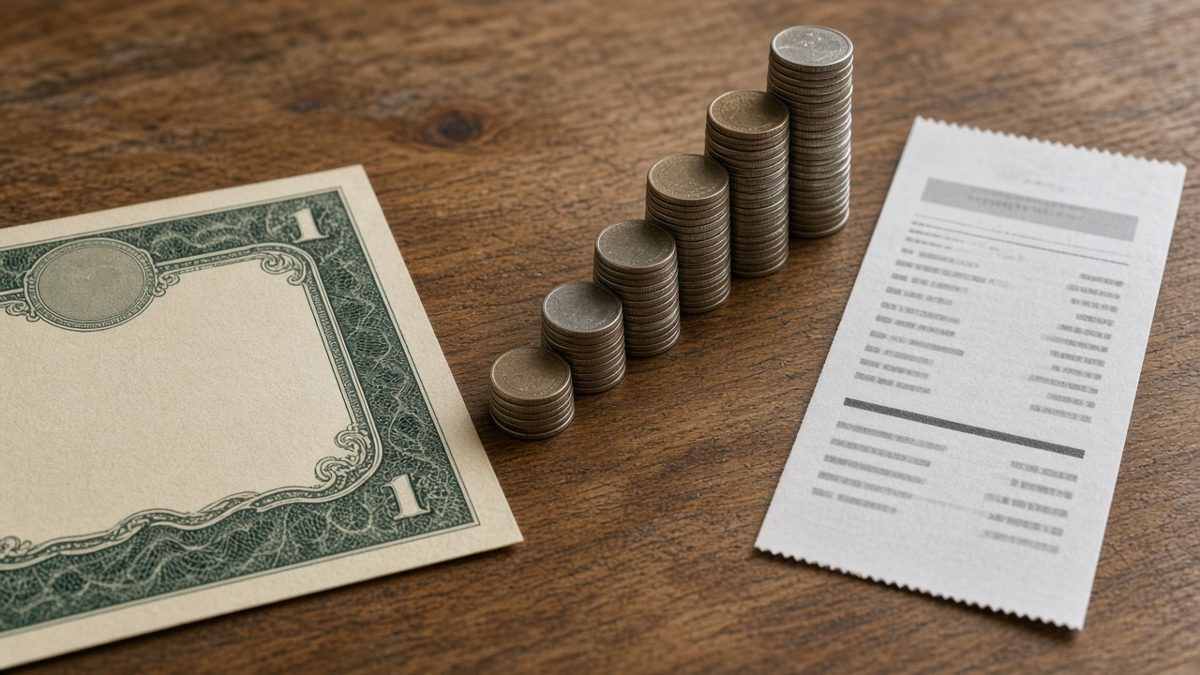
Inflation quietly erodes the value of cash. Series I savings bonds, issued by the US Treasury, are designed to counter that by paying interest that adjusts with inflation. They are backed by the full faith and credit of the United States, cannot lose nominal value, and offer tax advantages. They also come with purchase limits, a one-year lockup, and a small penalty for early cashing. This guide explains how Series I savings bonds work and how to decide whether they belong in your savings plan.
What Series I savings bonds are
An I bond is a non-marketable Treasury security. You buy it directly from the government, it cannot be sold to another investor, and it earns interest for up to 30 years. Interest is added to the bond’s value monthly and compounded semiannually, but you do not receive interest payments along the way. You collect the accumulated value when you cash the bond.
How I bond rates are calculated
Each I bond earns a composite rate made up of two parts:
- Fixed rate. Set at purchase and stays the same for the life of the bond.
- Inflation rate. A semiannual rate based on changes in the Consumer Price Index for All Urban Consumers (CPI-U). It is reset every six months.
The Treasury announces new rates each May 1 and November 1. The formula is:
Composite rate = fixed rate + (2 × semiannual inflation rate) + (fixed rate × semiannual inflation rate)
Rate timing for your bond
Your bond’s rate changes every six months from its issue date, not on May 1 and November 1 for everyone. A bond issued in March earns the rate announced the previous November for its first six months, then switches to the May rate in September.
Deflation protection
If inflation is negative, the inflation component can reduce the fixed rate, but the composite rate can never fall below zero. Your bond’s redemption value will never go down.
Current rates are posted on TreasuryDirect.gov. Because the fixed rate is locked in for 30 years, a higher fixed rate at purchase has long-term value.
Purchase limits
Each person can buy up to $10,000 in electronic I bonds per calendar year through TreasuryDirect. Separate limits allow additional purchases in certain ways:
- Paper I bonds through your tax refund. You can use up to $5,000 of your federal tax refund to buy paper I bonds by filing Form 8888 with your return.
- Gifts. You can buy I bonds as a gift for another person. A gift counts against the recipient’s annual limit in the year it is delivered to their account.
- Entities. Trusts, estates, and businesses with their own taxpayer ID can each buy up to $10,000 per year.
Electronic bonds can be bought in any amount of $25 or more, to the penny.
Holding rules and early redemption
- One-year minimum. You cannot cash an I bond during the first 12 months after purchase.
- Three-month interest penalty. If you cash a bond before it is five years old, you lose the last three months of interest.
- No penalty after five years.
- Maturity at 30 years. Bonds stop earning interest at 30 years.
Because of the one-year lockup, I bonds are not a substitute for the most liquid part of an emergency fund. Some savers keep a cash cushion elsewhere and treat I bonds as a second layer.
How I bonds are taxed
- Federal tax applies. I bond interest is subject to federal income tax.
- No state or local tax. Interest is exempt from state and local income taxes.
- Deferral. You can defer reporting the interest until you cash the bond or it matures. Most owners choose deferral.
- Education exclusion. Interest may be partly or fully excluded from federal income tax if you use the proceeds for qualified higher education expenses, subject to income limits and other rules. The bond owner must have been at least 24 when the bond was issued. Form 8815 is used to claim the exclusion.
When you cash electronic bonds, TreasuryDirect issues a Form 1099-INT.
How to buy I bonds
- Open a TreasuryDirect account. You need a Social Security number, a US address, a bank account, and an email address.
- Choose the amount and registration. You can register a bond in one name, with a co-owner, or with a beneficiary.
- Link funding. Payments come directly from your bank account.
- Track and redeem online.
Banks no longer sell paper savings bonds. The only way to get paper I bonds today is through a federal tax refund.
I bonds vs other inflation-protected and safe options
| Feature | I bonds | TIPS | High-yield savings | Treasury bills |
|---|---|---|---|---|
| Inflation adjustment | Yes | Yes, via principal | No | No |
| Can lose market value | No | Yes, if sold before maturity | No | Minimal if held |
| Annual purchase limit | $10,000 electronic | None | None | None |
| Liquidity | Locked 1 year | Tradable | Immediate | At maturity or sale |
| State tax | Exempt | Exempt | Taxable | Exempt |
I bonds vs TIPS
Treasury Inflation-Protected Securities also adjust for inflation but trade on the market, so their prices fluctuate before maturity. TIPS have no purchase limits and can be held in IRAs and brokerage accounts. I bonds cannot be held in retirement accounts. Investors who need larger amounts of inflation protection often use TIPS, while I bonds suit smaller, steady savings.
I bonds vs high-yield savings accounts
A savings account offers instant access, but its rate does not track inflation. I bonds may yield more when inflation is high and less when it falls. Compare the current composite rate with savings rates and consider how long you can leave the money untouched.
When to buy and when to cash out
Some savers time purchases around the May and November announcements. If the next rate is expected to be higher, buying just after the change locks in the higher rate for six months. If the current rate is higher, buying before the change gets six months at that rate first.
When deciding whether to redeem an older bond, compare its current composite rate, which depends on its fixed rate, with alternatives. Bonds bought years ago may have a fixed rate of 0%, while newer bonds may carry a higher fixed rate. Remember to factor in the three-month penalty if the bond is under five years old.
Common mistakes
- Buying money you may need soon, forgetting the one-year lockup.
- Misjudging gift limits, not realizing gifts count against the recipient when delivered.
- Forgetting about deferred taxes, then facing a large tax bill in the year many bonds are cashed.
- Losing track of old paper bonds. The Treasury runs a Treasury Hunt tool to search for matured, unredeemed bonds.
Related reading: Credit Utilization Ratio: How Card Balances Move Your Score and How to Manage Them and Sinking Funds: How to Save for Predictable Expenses Without Derailing Your Budget.
Frequently Asked Questions
How are Series I savings bonds rates set?
Each I bond earns a composite rate combining a fixed rate set at purchase and an inflation rate based on CPI-U. The Treasury announces new rates every May 1 and November 1.
How much can I invest in I bonds each year?
Each person can buy up to $10,000 in electronic I bonds per calendar year through TreasuryDirect, plus up to $5,000 in paper I bonds through a federal tax refund.
Can I lose money on I bonds?
The redemption value never declines. However, cashing a bond before five years forfeits the last three months of interest, and you cannot cash it at all in the first year.
Are I bonds taxable?
Interest is subject to federal income tax but exempt from state and local income taxes. You can defer federal tax until you cash the bond, and it may be excluded if used for qualified education costs.
Should I choose I bonds or TIPS?
I bonds cannot lose value and suit modest amounts. TIPS have no purchase limits and can be held in IRAs, but their market prices fluctuate before maturity.
This article is for general informational purposes only and is not legal, medical, tax, or financial advice. Rules vary by state and change over time; confirm details with the relevant agency or a licensed professional.